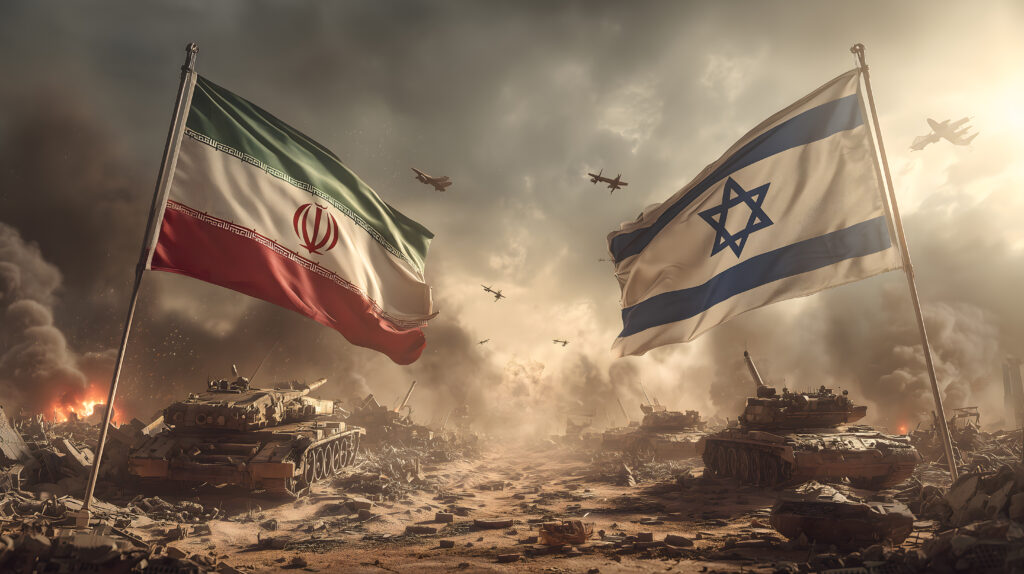
The 2026 Iran war began on February 28, 2026, when the United States and Israel launched surprise airstrikes on multiple sites and cities across Iran, killing Supreme Leader Ali Khamenei and numerous other Iranian officials. The campaign, codenamed “Operation Epic Fury” by the U.S. military, was the culmination of years of escalating tensions over Iran’s nuclear program, its ballistic missile capabilities, and its regional proxy network.
Iran responded with missile and drone strikes against Israel, U.S. bases, and U.S.-allied countries in the region. The fighting quickly expanded beyond Iran’s borders. Unlike the June 2025 twelve-day war, which curbed Iran’s nuclear capabilities, the current conflict has spread across at least a dozen countries, closed the Strait of Hormuz — the world’s major oil artery — and killed more than 2,300 people in the region.
For most Montrealers, the war began as a distant television event. Within days, it was reshaping their daily lives in ways both visible and invisible — at the gas pump, in their communities, and in their sense of personal safety.
1. The Energy Shock: Montreal Pays at the Pump
Perhaps the most immediate and tangible impact on everyday Montrealers has been the dramatic spike in fuel prices. Iran’s closure of the Strait of Hormuz disrupted 20 percent of global oil supplies and significant liquefied natural gas (LNG) volumes.
The price of oil hit nearly US$120 per barrel over the weekend of March 8–9, 2026, before settling back below $100 late Monday — up from about $64 in the days before the strikes began. Gas prices skyrocketed, with the national gas price sitting at C$1.54 for regular grade as of early Monday, up more than 20 cents in the past week, according to CAA.
For a city like Montreal, where commuters depend heavily on personal vehicles, diesel trucks supply the grocery supply chain, and heating fuel costs are already elevated due to Quebec’s cold winters, this kind of price surge ripples through the entire cost of living. When the price of diesel rises, so does the cost of delivering food, goods, and materials across the island.
Oil and gas account for about 1 percent of American GDP and some 7 percent of Canada’s; any gains that will arise in those relatively small sectors will be more than offset by the inflationary effects in the rest of the economy. Canada’s economy is worse yet in terms of energy intensity, in large part because the transportation system remains carbon-intensive. When energy gets more expensive, so does everything else, making Canadian manufacturers less competitive.
Economists warn the situation could create a combination of higher prices and slower growth, with inflation forecast to peak at over 3 percent year-on-year in the United States. In Canada, that inflationary pressure is expected to be similarly acute, affecting everything from groceries to construction costs.
2. Financial Markets and Montreal’s Economy
The war’s shockwaves have hit financial markets hard. Stock markets experienced declines, with the Dow Jones Industrial Average falling over 400 points on March 2. Broader economic forecasts warned of inflationary pressures and slowed global growth if the conflict is prolonged.
Montreal is home to major financial institutions, tech firms, aerospace companies, and a vibrant export economy. The conflict’s cascading economic fallout is now radiating well beyond the Gulf, reshaping global commodity markets, food systems, industrial supply chains, financial conditions, and geopolitical alignments — potentially for years to come.
Quebec’s aerospace sector — anchored by companies like Bombardier, Pratt & Whitney Canada, and CAE — is particularly sensitive to global disruption. Aviation has been significantly disrupted due to the closure of airspace on key flight corridors between Africa, Asia, and Europe, with several major airports in the Middle East — which collectively handle around 15 percent of global air traffic — also closed.
For energy-importing economies, the main transmission channel is inflation. Higher oil and gas prices raise the import bill faced by households and firms, squeezing real incomes and eroding purchasing power. For Montreal’s substantial manufacturing base, this means higher input costs at a time when the city was already grappling with trade uncertainty.
3. Food Prices and Supply Chain Stress
Less reported but potentially more consequential for ordinary Montrealers is what the war is doing to food prices. Fertilizers, many of which are derived from natural gas, have spiked in cost. Shipping route disruptions are adding weeks to delivery times and dollars to every imported item.
The Strait of Hormuz remains a critical global chokepoint where disruption threatens not just oil shipments but also fertilizer access and high-tech supply chains. Asymmetric economic shocks disproportionately burden import-dependent economies facing high inflation and debt.
Qatar declared force majeure on its gas exports after Iranian drone attacks, and it may take at least a month to return to normal production levels. Qatar supplies 20 percent of the world’s LNG. A prolonged disruption to LNG markets would further pressure natural gas prices globally, which in turn affects agricultural production costs — ultimately landing on grocery shelves in Montreal’s neighbourhoods.
4. The Iranian-Montreal Community: Hope and Fear
Montreal is home to one of Canada’s most significant Iranian diaspora communities. As of 2016, there were approximately 23,410 people of Iranian origin in the Greater Montreal Area, making it the third-largest concentration of Iranian Canadians after Toronto and Vancouver.
The reaction of this community to the war has been deeply divided — and deeply human. On the very day the strikes began, Iranian Quebecers took to the streets of Montreal and Quebec City, some waving flags of pre-revolutionary Iran, others carrying photos of Reza Pahlavi, the exiled son of Iran’s last Shah. The mood at both rallies was celebratory, with music blaring, people smiling, and those in attendance expressing hope for a better future for Iran.
But not all Iranians in Montreal share that view. Atena Barforoushi, an Iranian chef and activist based in Montreal, said she could not sleep for fear and worry — not only for her family in Iran, but for everyone living under the threat of bombs. She noted there is no infrastructure to keep people safe, no sirens to warn civilians of incoming attacks, and a government which is “not there to protect” the most vulnerable.
This emotional divide — between those who see the strikes as long-overdue deliverance and those who fear for civilian lives — runs right through the Iranian community on Montreal’s streets, in its Persian restaurants, at its cultural organizations, and in heated family group chats crossing time zones.
5. Montreal’s Jewish Community: Solidarity and Security Concerns
Montreal has one of the oldest and most established Jewish communities in North America, concentrated particularly in the areas of Côte-Saint-Luc, Hampstead, and Westmount. For this community, the Iran–Israel conflict has brought both a sense of existential stakes and heightened security anxiety.
In January 2026, even before the war began, some 70 Montrealers gathered in solidarity with the people of Iran, with the rally bringing together Kabyles, Jews, Iranians, and others to denounce repression by the Islamic regime. That solidarity has deepened since the war began — but so have security concerns.
Since the start of Operation Roaring Lion, there has been an identified surge in motivation and an increase in terrorist activity and threats from Iranian security agencies against Israeli and Jewish targets worldwide, according to Israel’s National Security Council. The NSC recommended community members remain alert in public spaces, refuse entry to buildings from unknown individuals, and be attentive when arriving at or leaving Jewish institutions or events.
U.S. intelligence considers Canada a “serious place of concern for Iranian activity.” CSIS revealed it had foiled several plans for lethal attacks against individuals Tehran identified as enemies of the IRGC. For Montreal’s Jewish community — already navigating elevated antisemitism since October 2023 — the war has added a new, concrete dimension of threat.
6. Community Alliances and Social Tensions
One striking development in Montreal has been the deepening of an unlikely but powerful alliance between the Jewish and Iranian communities. Montreal Jews and Iranians forged a coalition of Hindus, Kabyles, Iranians, and Jews to “create allyship,” which first came together in September 2024 for a demonstration outside Amnesty International’s Montreal headquarters denouncing what they called a “double standard” regarding repression by the Ayatollahs.
New polling from the Angus Reid Institute shows there is little consensus among Canadians about whether the path taken by Israel and the U.S. was the right one. Half of Canadians oppose the airstrikes (49%) while one-in-three (34%) are supportive, with significant differences along gender and partisan lines. In a city as politically engaged and multicultural as Montreal, these divisions play out in everyday spaces — on social media, in universities, in community centres, and in the city’s vibrant café culture.
7. Travel Disruptions Hitting Montreal’s International Hub
Montreal’s Trudeau International Airport serves as a major gateway between North America, Europe, and the Middle East. The war has directly disrupted air travel and commerce. Thousands were left stranded globally and repatriation efforts were described as the biggest since COVID-19. Airlines have increased ticket prices or cancelled flights to maintain cash flow.
The Canadian government advised all Canadians to avoid all travel to Bahrain, Iran, Iraq, Israel and Palestine, Kuwait, Lebanon, Qatar, Syria, the United Arab Emirates, and Yemen, and to avoid non-essential travel to Jordan, Oman, and Saudi Arabia. For Montrealers with family ties across the Middle East and South Asia, this has meant agonizing separation from loved ones during a crisis.
8. Canada’s Political Response
Canada has officially declared it will not join the war. Canada has “no intention” of joining the Iran war and was “not consulted” by the U.S. or Israel before the strikes, according to government statements. Prime Minister Mark Carney offered quick support for the United States’ and Israel’s military strikes on February 28, and has since faced criticism from multiple sides.
For Montreal — a city that has historically been more skeptical of military interventions and more vocally multilateralist than much of English Canada — these political choices carry significant resonance. Quebec public opinion has generally been more opposed to the strikes than that of other provinces, and Carney’s early endorsement created political friction in a province where the Liberal government needs strong support.
9. The Longer Shadow: Refugees and Humanitarian Concerns
Montreal has long been a city of refuge, and the war in Iran is already creating a new wave of displacement. The attacks have left enormous damage, with more than 2,000 people dead in Iran, Lebanon, and Israel, hundreds of thousands of people displaced in Lebanon, and hundreds of thousands of travelers stranded across the Middle East.
Canada’s immigration and refugee system will likely face pressure as Iranians fleeing the conflict and its aftermath seek safety in a country many already have family connections to. Montreal, with its existing Iranian diaspora and its French-language community that historically attracts Francophone immigrants, is likely to be a destination of choice.
Conclusion
The Iran–Israel conflict of 2026 is, in military terms, being fought thousands of kilometres from Montreal. But its effects are being felt on every block of the city — in the price of gasoline, the cost of groceries, the security briefings delivered to Jewish community centres, the divided gatherings of Iranian families watching the news, and the uncertainty hovering over the city’s internationally connected economy.
What Canadians really should hope for is a quick end to the fighting and a return to stability. Each day the war continues, that prospect looks increasingly remote, while the country’s economic challenges grow. Montreal has always been a city where the world’s conflicts find their echo — in its streets, its mosques and synagogues, its universities, and its politics. This war is no different.
FREQUENTLY ASKED QUESTIONS (FAQ)
Q: Will the Iran–Israel conflict directly affect Montreal’s security?
A: While Montreal is not a direct military target, Canadian security agencies including CSIS have noted increased IRGC-linked activity in Canada. Jewish institutions and Iranian dissidents in Montreal have been placed on heightened alert. The risk is not of missile strikes, but of targeted intimidation, harassment, or extremist violence inspired by the conflict. Montrealers are advised to remain vigilant and report suspicious activity to authorities.
Q: How much will gas prices rise in Montreal because of the war?
A: Gas prices in Canada rose by more than 20 cents per litre within the first week of the conflict, with the national average hitting C$1.54/litre. Prices are expected to remain elevated as long as the Strait of Hormuz remains disrupted. Montrealers who commute by car or rely on heating oil should budget accordingly and consider public transit where possible.
Q: Is it safe for Montrealers to travel to the Middle East?
A: No. The Government of Canada has issued advisories urging Canadians to avoid all travel to Iran, Israel, Lebanon, Iraq, Kuwait, Bahrain, Qatar, the UAE, Syria, Yemen, and Palestine. Non-essential travel to Jordan, Oman, and Saudi Arabia is also discouraged. Montrealers with family in the region should contact Global Affairs Canada for consular assistance.
Q: How is the Iranian community in Montreal reacting to the conflict?
A: Reactions are deeply divided. Some members of Montreal’s Iranian community — estimated at over 23,000 people in Greater Montreal — have celebrated the strikes as a potential end to the Islamic Republic’s repressive rule. Others, particularly those with family currently in Iran, are deeply distressed about civilian casualties and humanitarian conditions. Community organizations are working to provide emotional support and facilitate communication with relatives abroad.
Q: What sectors of Montreal’s economy are most at risk?
A: The most exposed sectors include aerospace (Bombardier, Pratt & Whitney, CAE), which depend on global air travel demand and supply chains; manufacturing, which faces higher energy input costs; food retail and distribution, which is hit by fertilizer and diesel price spikes; and financial services, which are buffeted by volatile global markets. Montreal’s tourism and hospitality sector is also affected by reduced international travel.
Q: Could Montreal see an influx of refugees from Iran as a result of the war?
A: It is likely. Canada, and Montreal specifically, has historically been a welcoming destination for Iranians seeking refuge. If the conflict produces significant civilian displacement or political upheaval — including the potential collapse or transition of the Iranian government — a new wave of refugee and immigration applications can be expected. Montreal’s French-speaking immigration community and existing Iranian diaspora make it a natural destination.
Q: Is Canada involved militarily in the Iran–Israel conflict?
A: No. Canada has officially stated it has no intention of joining the war and that it was not consulted by the U.S. or Israel before the strikes. Prime Minister Mark Carney expressed political support for the strikes but has committed no military assets. Canada’s role is limited to diplomatic engagement, consular services for Canadians in the region, and monitoring threats to Canadian security at home.
Q: How might this conflict affect Montreal’s housing and cost of living?
A: The inflationary pressures triggered by the conflict — higher fuel, food, and commodity prices — will compound Montreal’s already strained cost of living. Construction costs are expected to rise as energy and materials become more expensive, adding further pressure to a tight housing market. The Bank of Canada may be forced to maintain higher interest rates longer than anticipated if inflation spikes, making mortgages more expensive.
Q: What can ordinary Montrealers do in response to the conflict?
A: Montrealers can stay informed through reliable news sources, support local Iranian and Jewish community organizations providing humanitarian assistance and mental health resources, be mindful of the impact on neighbours from affected regions, report hate incidents or security concerns to police, and engage constructively in civic debates about Canada’s foreign policy. Economically, reducing fuel consumption and buying locally sourced goods can help mitigate inflationary pressures at the individual level.
Q: How long could these economic impacts on Montreal last?
A: Economists are divided. If the conflict ends quickly and the Strait of Hormuz reopens within weeks, many of the worst energy price spikes could recede within one to two quarters. However, if fighting continues for months, the inflationary and supply chain effects could persist well into 2027. Structural shifts in global energy markets and trade routes — once established — may take years to fully reverse. Montreal businesses should plan for at least 12–18 months of elevated uncertainty.